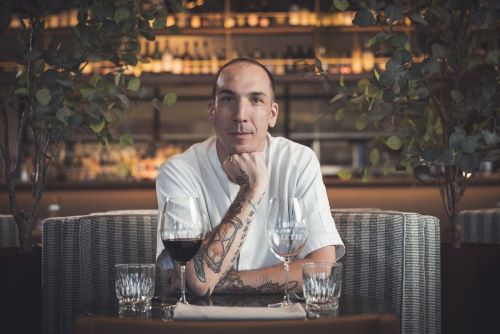
Interview: Dayan Hartill-Law

Dayan Hartill-Law is Executive Chef at Palette Restaurant in HOTA on the Gold Coast

Given this is the most asked question at your Restaurant, how would you best define Aussie Cuisine?

This has to be my favorite question to answer because I have forever run with a cuisine type of Modern Australian. For me Australia is made up of all of it’s parts, we are at our heart belonging to the indigenous people and their traditions, the native and endemic species of flora and fauna guide the understanding of the environment and the landscape. Our short history is one of migration and this in turn brought with it an Industrial Revolution that has also shaped the culinary landscape. It brought ingredients that allow us to really harness the diverse landscape Australia offers, it brought agriculture techniques that also have allowed us to bring multiple proteins to the forefront. Modern fisheries have also allowed us to delve into the rich aquaculture resources and understand the different times bring different species.

Is your culinary style influenced by your interpretation of that definition?

Unequivocally this sums up the way that I like to cook, looking for deep rich cultural connection. Then playing with those ideologies, modern takes on techniques, or interpreting indigenous ingredients, using indigenous ingredients through other cultural lens’ like bunya miso, quandong soy, candied lemon aspen. These all build the building blocks to our pantry to allow us to really have a unique style in the way in which we cook.

Which Chefs do you consider had the most influence in that evolution?

There have been so many incredibly influential chefs over the years, Peter Gilmore personally for me really shaped the way I look at food, his way with nature and looking at things as a whole steering away from the trends of the time being very classical and uniform and ensuring that lines are clean. Peter would often will the ingredients to his desire and allow the natural flow to shine. The way he was with flavor, also leaning into the indigenous ingredients list. Chefs like Jock Zonfrillo, Ben Shewry and a host of others also have shown great respect to Indigenous culture while educating diners on the incredible pantry that the indigenous kitchen holds, while doing it in an approachable fashion, that also pays respect to the deep cultural surroundings from the different ethnicities that emigrated to Australia.

What scope and direction do you think Aussie Cuisine has looking forward?

Australian cuisine truly has evolved at a rapid rate with the introduction of social media we see ourselves with immediate access to information. The ingredients are sought after as are experiences, like the dampa at Vue de Monde, the Northern Rivers endemic foraged fruits at Pipit, and the way I see our cuisine evolving is that we will lean away from central distribution and become hyper regional. This will allow us to give each region a voice, allow each region to evolve and showcase themselves. With Australia the size of Europe, we have so many varied climates that each has its own unique flavor profile and in turn voice.

Are there any specific ingredients that give us a unique and substantial point of difference?

There are so many ingredients that allow us to stand on our own, my favourite to use is the green ant, served delicately on a sashimi grade prawn. Outside of that there is the Ooray plum, the riberry falling abundantly from the trees at the moment, the quandong, the witchety grub. Then there is the way we can cheekily nod to the ‘bogan’ Australia with things like slipper lobster pie with tomato sauce, or the kangaroo parmi. We actively farm kangaroo, emu and possum. Then we also have incredible aquaculture systems with yabbies and marrons.

Do your mentor your younger chefs on understanding Aussie Cuisine?

I try to really teach into my teams that we are truly blessed with our location here on the Gold Coast, while the indigenous cultures had nomads, the Yugembeh people didn’t move as they didn’t need too. We have the ocean, the beach, the estuaries, mangroves, rainforest, dessert and bush all in the span of 40km. This means our environment is diverse, the ingredients and food resources are rich and this allows us to really look at what and who we are as a region. The mountain ranges surrounding us are all extinct volcanoes again resulting in rich agricultural grounds. The sea temperature fluctuates bringing different species at different times of the year again offering an intrinsic diversity to our plates.

When did you first start considering the question of defining Aussie Cuisine in your career?

I remember asking my 18 year old self this question and getting a not very wise answer. Something along the lines of Bogan centric cuisine being the forefront of cuisine in Australia. When really the history of Australia is the richness.

You recently collaborated with Marco Pierre White, did he ask about our Cuisine?

Marco was incredibly enamored with the stories of our region, we actually did a native tasting with him showcasing the types of things that we do like the quandong soy, the bunya miso, fermented riberry, pickled aspens. We also run a native mole which is over 400 days old and each day we cook the mole with different foraged ingredients the richness of the sauce is again intrinsic to who we are as a region. Marco also was able to talk to us about the things in our region that he has utilised before such as Rocky Point Aquacultures world leading practices, Stanbroke Beef’s incredible wagyu program and Australian Bay Lobsters commitment to sustainability.

Is there anything you would like to say on the subject that we haven’t covered? 

There is so much beauty in celebrating who we are today as a nation and the more we come together and celebrate our differences, the more we will be able to grow and develop our sense of who we are as a nation and the faster our food will develop. The young chef having a go, deserves to be admired, as they form their ideologies.


Grills and pavlovas

This article was originally published in 2017 as part of the Aussie Cuisine Project

Whether Australia has its own cuisine has been the subject of much debate. Australia’s cuisine is an adopted one. An aggregation of recipes, styles and techniques from all over the world, using a wide range of fresh and original ingredients. Almost every ingredient available in the Old World is now cultivated in Australia, together with many new and exotic varieties. This ready supply of both traditional and new ingredients has made it easy for Australia to accept cuisines from around the world.

Australia’s food is arguably amongst the best in the world and its cooking style is a crowning achievement of global popular culture. Australian chefs are in demand worldwide for their creativity and use of fresh, readily available ingredients. But this is not uniquely Australian “cuisine”. It is a globalised international cuisine. Whilst Australian cooking is of an international style, it is based on the cuisines of the cultures of its people. Australia has borrowed its cooking styles and techniques from other cultures, both through migration and active importation. Australia did not have the peasant classes that traditionally developed the cultural based regional cuisines of traditional cultures. However, modern Australian’s were all pioneers in their own way, seeking a new life in a new land. They brought with them their history and culture and modified this to suit their new lifestyles. In this sense Australia is developing a cuisine, as all cuisines evolve and change with time.

There are however many products that can be deemed to be “Australian”. One is perhaps, the barbeque or grill. Australia’s inhabitants have grilled food on an open fire for thousands of years. Today the backyard barbeque is a tradition. It is a style of cooking that is practised across all social classes and in almost all homes. It is simple and provides comfort and pleasure. It is the style of cooking practiced at Sizzler – Australian cuisine.

By Jeremy Ryland


The Country Women’s Association of Australia: The cornerstone of regional cooking

We look back to an article published in 2016 that acknowledged the foundational contribution of The Country Women’s Association to both Regional and Aussie Cuisine.

Formed in 1922, primarily with a socially driven mission statement to counter both the effects of isolation, and the lack of access to similar welfare and health facilities that the bigger cities enjoyed, the depression and war years saw them provide food and clothing parcels to those forgotten and seriously disadvantaged. Cooking was also identified as one way of raising money for worthy causes, and the success of those recipes led to the publication of various Branch cookbooks, that developed a loyal following, even to this day. The consolidated CWA cookbook has been in print since 1937.

Whilst the cookbooks of modern Chefs – even from the elite within the industry – can still contain recipe and technical oversights, the CWA recipes are proudly renowned for withstanding scrutiny well over half a century later, also allowing the home cook greater flexibility in adapting those recipes to what ingredients they may have at hand. There is little doubt that it significantly influenced regional Australian Cuisine in a collaborative way, and inputted into the staples of our formative cuisine, before immigration started to change the way we thought about, and viewed food from that point on. The humble CWA recipes were also both very nutritional and sustainable, and occasionally drew on indigenous ingredients like muttonbird (shearwaters), which featured in their Soups and Stews edition. Secondary cuts and offal – now trendy in modern cuisine – featured prominently in their cookbooks with recipes like pig’s cheek mould, croquettes of brains, steamed liver, giblet and celery soup.

In future articles, we will look at how regional cuisine has developed its own unique sophistication, and is now influencing mainstream national cuisine through restaurants like Brae, Royal Mail Hotel and Provenance. It is not too long a bow to draw, that the CWA played some part in that evolutionary journey, by laying both the cultural and culinary building blocks for that sense of maturity to develop. The baking component of their recipes has clearly influenced the development of pastry in this country at a fundamental level, with not only the standards rigidly tested at Royal Agricultural Shows annually, but providing chefs with the confidence to interpret and execute more complex desserts. Most importantly, this incredibly robust and patriotic organisation provided our Nation with support and strength throughout some incredibly difficult and challenging times.

By Dane Richards

Interview (2018): Brian Geraghty

We interviewed Chef /Owner Brian Geraghty of the acclaimed Berowra Waters Inn in 2018 about the influences of immigration, native ingredients and regional cuisine.

What is Australian cuisine?

To its core; it is the tapestry of our nation’s great multicultural past, in essence, a microclimate of nations trying to identify together in unity.

What do you think were the primary influences behind its evolution?

Postwar immigration. World War two brought a more continental European cuisine, and the immigrants post the Korean and Vietnam wars, brought our love and appreciation of South East Asian food, and of course, our colonial British heritage played its part.

What is your heritage, and what part has that played in the dishes on your menu?

I immigrated to this country at the age of four from Ireland. This fact has made the sourcing of proteins on my menu imperative, as it is the core of Irish cooking.

How important is the integrity, provenance and sustainability of produce in both inspiring and influencing your dishes?

Of the utmost, as we all move forward in this vocation as chefs, we must all realise that this is the most important factor. I could not be more serious on this point, as we must all champion our great land and all it has to offer.

Sustainability harbours integrity, provenance demands sustainability, they all coexist together.

What part has produce played in the overall development of modern Australian cuisine?

It has played a pivotal role, as a new set of immigrants moved to our shores, they brought their produce and cooking methods, and as a nation, we shaped that into our cuisine and forged our food identity from that.

What particular produce in your opinion quintessentially represents Australia on a plate?

I would say seafood. It is all around us (literally) in every stage of our development to get where we are today in identifying Australian cuisine, be it Aboriginals eating Sydney rock oysters, to ceviche of snapper.

Is Australia properly showcasing the diversity of its produce to International visitors?

No, but we are on our way to showcasing it well. There is safety in big overseas produce, whether it be; truffles from Alba, or foie gras from the Dijon, but there is not too much safety in wallaby or warrigal, but we must preserve it. If not now, when?

How important is it for the untapped potential of Indigenous influence on Australian cuisine to be fully realised?

Unfortunately, this is a blight on our nation’s food heritage. Whilst the energy in this area is always growing, there just needs to be more readily available produce both to the public and commercially, and a better understanding for proper applications – lemon myrtle cheesecake is not the answer.

What native Australian ingredients have you successfully incorporated into your dishes?

Lemon aspen and finger limes, as acidity is paramount to cooking well. This is an obvious choice, but they do work well with my cooking style.

Are the hospitality industry, and various levels of government, doing enough to encourage young Indigenous chefs?

No, but in saying that, our industry and levels of government are not doing enough to entice people to cooking generally. I believe the lack of regional infrastructure is creating a lack of regional chefs, which in turn is furthering the void.

What is your understanding of bush tucker?

Until recently, the only consideration given to bush tucker was survival in the outback, which is such a shame, as my understanding is more that of an untouched pantry.

How influential was the CWA to Australian Cuisine in the postwar years?

Rather, not just scones and jams, lamingtons and pies; but more importantly how we dine together, by making food for regional towns and fairs, installing our identity of shared dining.

What is your quintessential memory of an iconic regional Australian dish?

Apple pie in Bilpin.

Did the foundations of regional cuisine influence modern Australian cuisine in any way?

Yes, by being humble and delicious, thankfully long gone are the days of stacked foams and airs. The foundations of regional cuisine have shown modern cuisine how to be modest and unpretentious.

Do you think regional cuisine of recent times has developed its own sense of sophistication and identity?

Yes, just look at restaurants in the regional areas, from Biota Dining to Brae, Provenance to Clementine, and let’s not forget that the Chico roll is from Bendigo!

It is our intention to re-interview all Chefs to see if their viewpoints have changed as the culinary landscape has shifted.

The Journey Continues

In 2016, the Publisher of Gault&Millau Australia Fritz Gubler decided to commence a project to define broadly what constituted Australian Cuisine. Having published G&M Guides in Australia from 2014, a large portion of the restaurants reviewed indicated that they served “Modern Australian Cuisine”, but most were unable to give an informative explanation, or even the defining characteristics of such a cuisine at that time. It was this lack of a clear answer that gave birth to the AussieCuisine project, with its mission statement being:

“To define the current cultural cuisine of Australia whilst acknowledging its past and offer guidance for its future. To advocate its values domestically and internationally by providing vested industries a clear identity to promote the vast and talented culinary landscape within Australia.”

What originally was planned as a three month project, ran for nearly three years reaching this conclusion about Aussie Cuisine:

After presenting this summary to Industry, and whilst being largely acknowledged as being largely representative, Chefs raised further questions about the regionality of our cuisine, and clearly we knew that outcome was purely just a capture at one point in time. No sooner than we wanted to further explore the subject COVID-19 hit, and we suspended the project whilst the Industry, and our society fought to survive.

Since the Pandemic, I have continued to review Restaurants for News for The Food Lover and other peak Industry organisations. The passion to advocate for our Chefs and Aussie Cuisine on the World stage has burned even more deeply, alongside one of the foundation members of the project Jeremy Ryland. In that time, we have seen a significant progression in Aussie Cuisine since our conclusion, and we want to capture that from both the Industry and diner’s perspectives. Aussie Cuisine belongs to us all, and we are here to bring those stories together in one place for us to share our viewpoints.

Jeremy and I will be reaching out to you for contributions, and we will accept all opinions, as food is a very subjective and personal medium, so I hope you will come along for the journey, and we look forward to collaborating with you all.

Let’s discover what Aussie Cuisine is together!

By Dane Richards