First of its kind Australian Native Food Festival to celebrate First Nations flavours at Carriageworks

A powerful celebration of First Nations culture and native Australian ingredients will take centre stage this September with the launch of the inaugural Australian Native Food Festival, presented by Indigiearth and proudly hosted at Sydney’s Carriageworks. The two-day event, held on 27th and 28th of September, invites guests to connect with Aboriginal culture through food, music, art and storytelling.

Spearheaded by Ngemba Weilwan woman and Indigiearth founder Sharon Winsor, the first-of-its-kind festival will showcase some of the country’s leading Indigenous chefs, businesses and creatives, offering an immersive journey into the world of bushfoods and First Nations culture. Indigiearth is a fully Aboriginal-owned and operated Native food and hospitality business, producing premium Native foods, beverages, ingredients, and botanicals crafted from ethically sourced and sustainably harvested Australian ingredients. 

The Australian Native Food Festival will offer a rich and immersive program celebrating Aboriginal culture through food, education, and performance. Across the two-day event, visitors can attend live cooking demonstrations by celebrated chefs including Ben ShewryKylie Kwong and native grains expert, Kerrie Saunders. They can also browse an Indigiearth pop-up cafe, market stalls from indigenous owned and operated native ingredient producers, and take part in bushfood masterclasses.

The festival will also offer inspiring discussions exploring the future of native foods and Indigenous food sovereignty, featuring trailblazers such as Raylene Brown (Kungkas Can Cook), Ronni Kahn (OzHarvest), Pat Torres (Mayi Harvests), Jenny Khan (The Unexpected Guest), and Aunty Beryl, founder of Yaama Barrgay. Cultural performances, live music, and storytelling will run throughout the event, creating an atmosphere of connection and celebration. More than 18 Indigenous-owned brands will be showcased, including IndigiGrow, Jala Jala TreatsJiwah by Clarence SlockeeKakadu Kitchen and many more.

“This festival is more than a showcase, it’s a celebration of Country, culture and connection through food.” says Sharon Winsor, Indigiearth Founder, CEO and executive chef. “My connection to Native foods saved my life. It provided me with a deep cultural anchor, and allowed me to overcome adversities with resilience and purpose. We’re sharing the stories of the people who grow, harvest, cook and protect these ancient ingredients with the broader community. It’s about honouring our past while creating a stronger future for native foods and First Nations voices.” 

The Australian Native Food Festival is free for general admission and will run between the 27th and 28th of September. It is proudly supported by Carriageworks, a leading cultural hub renowned for championing First Nations arts and innovation. 

Chef demonstrations are ticketed and will go on sale in the coming weeks. For full program details and to register please visit: https://carriageworks.com.au/events/australian-native-food-festival/

Interview: Grant Parry

Having worked for both Gordon Ramsay and Peter Gilmore, it ideally places Chef Grant Parry in a perfect position, not only to comment on the contrast in their styles, but also on the approach and philosophy of their cuisines. Whilst Gordon has refined his classical background into a Modern adaption of British cuisine, underpinned by French techniques, Peter has explored and redefined the boundaries of Modern Australian. Similarly, Grant continues to challenge himself in establishing his unique voice on the plate, showcasing our spectacular local produce in new ways that resonate with our diners.

How would you best define Aussie Cuisine?

An unfinished story!

Rooted in Western European cooking but influenced by all other country’s ingredients and techniques, Aussie cuisine is constantly shaping into an anything goes cuisine not bound by anything.

When I grew up we ate pork sausages, we still eat pork sausages, but with lemon myrtle in them, just small changes which over time will be cumulative and there is a long way yet to go in this adventure that is Aussie cuisine.

Is your culinary style influenced by your interpretation of that definition?

    Yes – my food style is constantly evolving, and I’ve always made a rule within myself to never do the same thing twice, but something I can always build upon. Aussie cuisine is ever evolving along with the customer’s needs to keep moving.

    In saying that we live in two realities now, the Instagram reality and actual reality. Spaghetti bolognaise isn’t going to make an Insta feed, but is always the bestselling pasta dish in a restaurant. These days at Cucina Vivo I’m trying to fuse both together to make something people are comfortable with, and will post about. I think if you can win at that, you win food game these days.

    Which Chefs do you consider had the most influence in that evolution?

    Gordon Ramsay was the biggest for me, I spent six years working for Gordon in three different countries and multiple restaurants.

    Gordon was always about giving the people what they want, knowing the customer and giving them the best they could be given.

    Peter Gilmore was another one, he thought completely different to other chefs, all the chefs I worked for previously worked from a recipe book, where Pete worked from his mind.

    I was part of the team that achieved quays three hats and his process was super different. I use more his process when working with new ingredients, just cook it up a few different ways and see what works.

    What scope and direction do you think Aussie Cuisine has looking forward?

    Aussie cuisine will continue to evolve based on the influences of other kitchens and the ingredients we use, the native food is largely untapped as well as the seashore, seaweeds and other sustainable ingredients will be explored more and more, as chefs start to experiment.

    How important has local produce been in shaping your culinary narrative?

    Immensely, you just have to look around at all the local “food bowls” which supply Sydney and every capital city, with fresh, seasonal produce all year long. We work as a team to produce our dishes highlighting this produce.

    Are there any specific ingredients that give us a unique and substantial point of difference?

    This easily would have to be Australian endemic plants species like the Myrtle family, Rose Myrtle, Lemon Myrtle, Cinnamon Myrtle can all be used in many ways, it’s something you can’t get anywhere else.

    Both yourself and Dayan Hartill-Law recently introduced High School students to Native Ingredients. Can you tell us about that experience, and what they took away from it?

    Myself and Dayan are very lucky to be able to be part of an agricultural program such as the one at Beenleigh Stage High School. The school is basically full of food like eggplant, bananas, strawberries, lettuce, crayfish, citrus and all the native species like Davidson plum , saltbush and native mulberries. It’s a serious privilege to go through the grounds with the students and get them tasting and smelling all the food around them. The students take a lot out of the dinners in terms of confidence and experience working with professional chefs and seeing our enthusiasm at the food all around them, that has been there in front of them the whole time.

    When did you first start considering the question of defining Aussie Cuisine in your career?

    Aussie cuisine has taken many different forms, when I started my apprenticeship at the time, the Bush Tucker era was just winding down where chefs threw wattle seed powder in mash potatoes, then the cuisine went more Asian influenced, and it’s kind of stayed like that.

    When I make a menu now and it needs to be Modern Australian. I feel like I can use pretty much any cuisine, and elevate it with local ingredients for a distinct point of difference.

    It’s always a balancing act trying to create something people will eat, but is also different.

    Interview: Darren Templeman

    Working in London with culinary heavyweights like Bruno Loubet, Gordon Ramsey, and Marco Pierre White executing the foundations of French Cuisine at the highest level, makes for an interesting perspective, as his time in Australia has seen his cuisine seismically evolve and shift to opening Izy Aki in Paddington featuring a Kappo Yakiniku styled approach. It also showcases the best of Australian produce, sakes and native ingredient cocktails.

    You have been named by two leading Industry figures recently, as being a key Chef of our culinary evolution. How would you best define Aussie Cuisine?

    Firstly, it is an honour to be mentioned as a key chef of our culinary evolution, which I thank them very much. Aussie cuisine for me, is not just about the indigenous ingredients which have become restaurant trendy the last few years, but a coming together  of all the great cultures which make up the Australian society. I have been lucky enough to experience first hand over the past 25 years from the backyard “yugo” BBQs drinking home made slivovitz and enjoying pig on a spit to modern day Korean BBQ and drinking Soju! Every culture will bring a tasty flavour to the Aussie cuisine table. The sharing of food, the breaking of bread and the toasting of health is the common denominator which in my eyes is the definition of aussie cuisine.

      Which other Chefs do you consider have had the most influence in that evolution?

      When I look back to when I first arrived there was people like Lyndey Milan and Jason Roberts on “get fresh” who where teaching people about the art of good cooking and a shared table, then of course there is Damian Pignolet, then Tim Pak Poy moving to Chui Lee Luk at Claudes restaurant redefining the classic French style with a (at the time) unique Aussie twist. Moving to the modern era, to me, Brent Savage along with Nick Hildebrandt are the epitome of modern Aussie cuisine, which shows in spades at every restaurant they open, highlighting the quality of produce that we have here in Australia.

      What scope and direction do you think Aussie Cuisine has looking forward?

      The scope is endless, as long there are forward thinking chefs, along with forward thinking food media. As for direction, I feel with our ever closer proximity to Asia, these food cultures will be the ones that really start to shine, more than what we are seeing already.

      Are there any specific ingredients that give us a unique and substantial point of difference?

      Rock lobster, WA marron, Syd rock oyster, WA scampi, QLD reef fish, the quality of our cattle farms are second to none, producing some of the most highly sought after beef in the world, really I could go on and on. Also not forgetting the Aussie truffle farms, which end up on the plates of 3 starred Michelin restaurants all over the world.

      How important has local produce been in shaping your culinary narrative?

      Immensely, you have to look around at all the local “food bowls” which supply Sydney and every capital city, with fresh, seasonal produce all year long. We work as a team to produce our dishes highlighting this produce.

      As a mentor, how do bring awareness of this evolution of our cuisine to younger Chefs?

      We have to give the younger chefs coming through more credit than what they currently receive, they are not stupid, they can see the quality what they have around them and feel the luck to be handling such produce. When it comes to the future evolution, then the new guard will look to add a little of their background onto the scene which will only make it richer.

      Is there anything you would like to say on the subject that we haven’t covered? 

      I feel moving forward Aussie cuisine has a bright future, as we embrace the multiculturism of our lands and enjoy one big shared table.

      Interview: Nelly Robinson

      You are opening your 2025 program at NEL with a Native Australia themed menu. In your opinion how would you best define Aussie Cuisine?

      Since I arrived in this country, Australian cuisine has evolved. Initially, it was very mixed and not really well defined. As I gained greater exposure and I met the native people of Australia, I quickly realised the native ingredients which cannot be found anywhere else in the world are really what makes Australian food so authentic. Salt bush, lemon myrtle, pepper berry, wattleseed are all native to Australia. Local Spanner crab and kangaroo need to used more and more too.

      Which Chefs do you consider had the most influence in that evolution?

      My dear friend Jock Zonfrillo who is not with us anymore was a trailblazer. What Jock did for native food in Australia really put Australian food on the map. I hope I can honor him and follow in his footsteps. Be it in Australia or whenever I travel the world to do dinners, to really put our native food and ingredients at the fore.

      You are arguably one of the most innovative Chefs in Australia, conceptually how did you go about selecting the flavours of Australia for the Native Australia menu at NEL?

      Thank you! I pride myself on changing up and also bringing something different to the dinner table. With the Australian menu, and how we come up with the ideas, we look at the native ingredients and how we can best showcase them. We endeavour to best flavour match everything. At NEL we have an amazing Spanner crab taco (which I am so proud of) is going down an absolute treat with our diners, as well as our version of the iconic Tim Tam served in the form of a map of Australia with a marigold and yoghurt sorbet.

      What scope and direction do you think Aussie Cuisine has looking forward?

      I just hope people start having these amazing ingredients in their pantries at home. You can walk along tracks, streams, cliffs…there is food there. Strawberry gum in the side of the road, lemon myrtle trees, paper bark…we cook with all of this at NEL. You can go foraging for amazing Warragal greens, Neptune pearls and kelp seaweed – these ingredients have been around for centuries but not everyone uses them. I hope this will change.

      Are there any specific Native ingredients that give us a unique and substantial point of difference?

      This difference we have in showcasing native ingredients is that we work with First Nations people on the Central Coast and up north. We are so very fortunate to be working closely with this truly wonderful group of human beings. The have educated my team and myself in how to best use these amazing ingredients. We are constantly evolving with them and receive their blessing in how we incorporate these ingredients. We are so proud of what we have achieved together and we love seeing the diners at NEL who appreciate and so enjoy it.

      Being an ex-pat Brit provides you with a very objective perspective – what in your opinion have been the driving influences on Aussie Cuisine?

      I think being an ex-pat Brit, as was Jock and what he did, there are no boundaries for us to learn from and about these amazing ingredients. So we are trying to help people to feel comfortable using them, as we continue to learn ourselves. We need to keep working directly with the First Nation farmers and growers and driving this evolution of Australian cuisine and how it is defined.

      Is there anything you would like to say on the subject that we haven’t covered?

      Use these amazing ingredients which are on our doorstep. When I am fortunate enough to travel the world and cook with some of my dear colleagues and friends, or when they come to Sydney themselves and indeed cook at NEL, they are gobsmacked with the flavours and options we have in our very own native ingredients. They have often never heard of these ingredients. As a chef, to use a ingredients you have never heard of or seen before, is an absolute dream come true. For me it is simple. We are in Australia. Use Australian produce. Let’s use it. Let’s support the local farmers who need our help to sustain their businesses. Let’s keep pushing as a nation to showcase these incredible flavours and ingredients

      https://www.nelrestaurant.com.au/

      Interview: Stewart White

      There is no sharper observer of our culinary scene, not only from his viewpoint as a National Chief Judge for a peak Industry Association, but as a successful PR and Marketing expert, and leading Hospitality Professional

      As one of the most highly respected and long-standing Industry figures, in your opinion how would you best define Aussie Cuisine?

      Australian Cuisine rubs shoulders with the notion of Modern or Contemporary Australian Cuisine. They both evolved from the culinary influences of ethnic (and more recently Indigenous) communities that have become part of Australia’s Anglo heritage landscape. It is an inspirational melting pot of the edible cultural elements of its immigrants and first nation bush tucker. It is tempered and massaged by combining their techniques and ingredients with Australian produce, together with the influence of the local climate and seasons. It’s a blending of European and Asian flavours, combined with modern, global traditional and artisanal techniques to often produce unique but indirectly familiar eating experiences that resonate with the contemporary Australian palate.

      Which Chefs do you consider had the most influence in that evolution?

      Peter Gilmore, Martin Benn, Andrew McConnell, Tetsuya Wakuda and Raymond Capaldi I’ve admired for their cutting-edge menus. Brent Savage and Josh Niland push the outside of their respective culinary envelopes. Flying under the radar, Darren Templeman, employs his French classical training to produce less-is-more hybrid dishes that exude a passport of global influences. But cast your mind back to 1984 and Jean-Paul Bruneteau and his Sydney Rowntree restaurant, with servings of witchetty grubs and a still memorable roasted wattle seed pavlova. Jean-Paul went on to fly the Australian food flag at Woolloomooloo restaurant in Paris in 2001, serving kangaroo with Tasmanian pepper berries (much to the chagrin of movie star turned animal liberationist, Brigitte Bardot). Among other notable homegrown ingredient champions, Andrew Fielke’s extraordinary Red Ochre in Adelaide, brother and sister bush tucker pioneers Raymond and Jennice Kersh at the iconic Edna’s Table. Indigenous chefs Mark Olive and Clayton Donovan, Kylie Kwong delivering bushtucker Chinese specialties. And let’s not forget the late Bill Grainger who put new world Aussie breakfasts on the global map.

      What scope and direction do you think Aussie Cuisine has looking forward?

      The sky’s the limit, so long as it isn’t manufactured meat.

      Are there any specific ingredients that give us a unique and substantial point of difference?

      Indigenous produce like wattle seed, lemon myrtle, pepper berries, Davidson’s plums and muntries – and who could forget the macadamia nut that Hawaii so efficiently appropriated. We ran away from our macropods – kangaroo and wallaby – hard to find on menus these days, although much is sold overseas. Poland being the biggest – a lot of Bigos stew?? Saltbush grazed livestock has a unique flavour especially given the current propensity to cook with an open flame.

      You have travelled the world, and indulged in cuisine from a diversity of cultures, what in your opinion have been the driving influences on Aussie Cuisine?

      Obviously colonial British food origins hold sway with its Mother England roots. Then the subsequent influences from the migration of Cantonese gold rush Chinese, to the post war Mediterranean immigration of Greeks, Italians and Lebanese. And French as the corner stone of haute cuisine and cooking techniques. French has had a resurgence in its bistro form, but its time-honoured techniques were always there as the backbone of classical culinary training and the discipline of the kitchen brigade. Italy has evolved and morphed from its crowd-pleasing Aussie favourites of Bolognese and pizza persona to proudly exert the influences of its regional differences. From the obligatory arancini for event finger food to tiramisu and panna cotta to finish. Chinese still holds sway albeit with the once ubiquitous Cantonese comfort food being challenged by regional mainland cuisines. There’d be no Chiko Roll without the spring roll. The subtlety of Japanese increasingly lends itself to be pushed, pulled and appropriated to complement, and be integrated into, almost any direction of Aussie cuisine.

      You are also an authority in Wine, how important is terroir in defining our identity?

      In Australia varietals generally define a perceived framework of drinking expectation to consumers, while terroir distinguishes its regional uniqueness. Viticulturally, this wide brown land is a vast and varied piece of real estate. It is not a one-size-fits all. It is a mosaic of stylistic endeavours that reflect their terroir. Coonawarra reds from terra rosa soil, big Barossa reds like Grange and Hill of Grace shiraz, the elegance of Margaret River wines, the uniqueness of Hunter Valley semillons and the Burgundian Yarra Valley offerings. On a global stage, Australian wines still continue to imply sunshine and lifestyle. Acknowledgement of the regional and terroir subtleties is growing locally and abroad.

      Welcome to Restaurant Australia

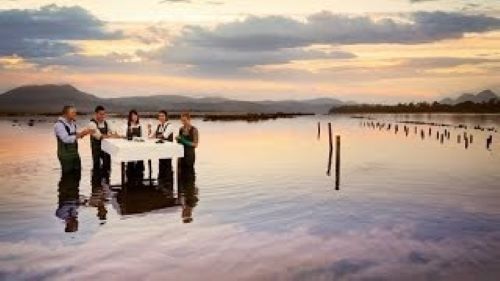
      Discover Australia’s bounty of food and wine experiences. Take in the Barossa Valley by hot air balloon, sample fresh oysters on Freycinet Peninsula, toast a Sydney sunset at Quay and dine under the stars at Uluru

      This incredible Restaurant Australia promotion campaign by Tourism Australia was launched in 2014, and some ten years on, it is still arguably the best visual representation of our culinary and wine landscape produced to date.

      Image credit: Tourism Australia

      Interview (2016): RJ Lines

      We interviewed Chef RJ Lines, now at Benny’s, about the influences of produce, native ingredients and regional cuisine

      What is Australian cuisine?

      A unique blend of Asian, European and traditional native produce.

      What do you think were the primary influences behind its evolution?

      I think the main influences half a century ago were the European influences, especially British, Greek and Italian, and that has shifted into a heavy South East Asian presence, and now the emergence of Australian native and indigenous produce.

      How important is it to fully understand the integrity, provenance and sustainability of the produce that you source?

      For me personally, it is the most important. Produce must be seasonal, sustainable and as local as possible. It just makes sense. I believe it is a knock on effect that hopefully the general public and wider food community can embrace and spread.

      What artisian produce has recently inspired and gained your respect as a chef?

      Recently it is the heritage beef program from Richard Gunner. A unique rare breed cattle program of “heirloom” beef breeds that are both pasture raised and dry aged. It has a great story bringing these once highly prized beef cattle back to the forefront from modern factory farming.

      Has important is it for the untapped potential of Indigenous influence on Australian Cuisine to be fully realised?

      There is a recent interest in the Indigenous flavours which I see as “up and coming”. It’s exciting, and I think out of respect, we need to be exploring it deeper. It has been an untapped market and is not yet fully realised.

      What native Australian ingredients have you successfully incorporated into your dishes?

      Finger limes are a favourite of mine, and we also have a native bee hive in our garden, which we are still waiting to yield the benefits from. Very recently, I received my very first Magpie goose from the Northern Territory. It’s a really unique wild bird that I’m excited to experiment with.

      Do you think regional cuisine of recent times has developed its own sense of sophistication and identity?

      Slowly I think it has. There are some outstanding regional restaurants out there like Biota, that seem to be leading the charge as chefs are really embracing the local, sustainable, native ethos. Also local to us, the team at Cornersmith are embracing their inner-city regional style cuisine.

      What is your quintessential memory of an iconic regional dish?

      In the mountains in the north of Italy, in what almost looked like a dive restaurant in a small town. I remember the wild boar ravioli made from chestnut flour, and also really simple stinging nettle pasta with a rich tomato sauce. I can picture it now almost 10 years on.

      It is our intention to re-interview all Chefs to see if their viewpoints have changed as the culinary landscape has shifted.

      A milestone in our culinary journey

      This presentation explained the methodology behind the outcome reached by the AussieCuisine Project Team in 2018

      What is AussieCuisine?

      Ask anyone for their opinion and you are likely to get answers ranging from “I don’t know” to “I know it when I taste it” and everything in between.

      In our most recent Gault&Millau Australia review of dining establishments in Melbourne, Sydney and Canberra, more than 300 restaurants indicated that they serve “Contemporary Australian Cuisine”, but most were unable to give us an informative explanation or even the defining characteristics of such a cuisine. It was this lack of a clear answer that gave birth to the AussieCuisine project.

      The AussieCuisine Project is designed to explore and define the essence of Australian Cuisine.

      For nearly three years we have interviewed about 35 chefs and food experts. We have held several forum discussions and researched over 125 articles and texts on Australian food and culture.

      We know that Australia is a multicultural society developed over 200 years of immigration…our food is the food of our pioneers – the original indigenous society, British convicts and colonists, Chinese gold hunters, European refugee migrants, Asian refugee migrants, other displaced migrants and people who just want to be here.

      So Australian eateries typically try to keep everyone happy by specialising in everything!

      • The French:
        • They brought us the basic cooking technique.
      • The Chinese:
        • They established our eating-out scene.
      • The Greeks:
        • They introduced us to the coffee shop concept and the mezze plate, which is the foundation of the share plate trend.
      • The Italians:
        • Their pasta and pizza became some of our most popular dishes.
      • The Japanese:
        • Their cuisine reflects the best of our coastal lifestyle.
      • Our Asian neighbours:
        • They added vibrancy and flavours to our cuisine.
      • And of course the contribution of Our Indigenous First Australian’s cannot be ignored. Whilst often thought of as being simple hunter/gatherer survival food it is now emerging that the ancient Aboriginal Australian’s developed many modern food technologies including cultivation of grain, aquaculture and even bread making.

      Australia exhibits a global cuisine, borrowing styles, techniques and recipes from around the world. Australia’s cooking is exciting, dynamic and growing – perhaps as a result of not having a long cultural history. Australia does not seek to retain a traditional regional character, as does Italy, so is free to experiment and create new fusion recipes.

      So after this detailed and on-going research, we have concluded that Australian Cuisine is…

      ‘A fresh, light, vibrant and innovative cuisine; featuring the diversity of Australian inland and coastal produce and reflecting our relaxed outdoor lifestyle.’

      WHY???

      Fresh:

      Australia is a large country and is lucky to have a varied supply of fresh ingredients all year round. Fresh food was of course vital to our Indigenous people and has had a major influence on the Aussie Cuisine of today

      Light:

      We tend to let the taste and flavours of our produce shine through without too much tampering. We feel there is no need to cover fresh food with substantial sauces or serve it with heavy accompaniments.

      Vibrant:

      We recognise the influence of our neighbouring countries on our cuisine. Not only have we adopted some of their dishes – for instance, salt and pepper squid can be found on most of our pub menus – but also our European-based cuisine has been invigorated with spices and umami flavour from Asia, adding a tangy and vibrant punch to our food. Often our food has “wings” and it “sings” compared to Western cuisines. Our flavour profile doesn’t hide behind the subtle nuances of European cuisine.

      Innovative:

      Aussie chefs tend to be more open-minded to new culinary influences and have a sense of freedom to experiment with new produce, techniques and cuisines. Whilst in Europe, chefs tend to preserve their traditional gastronomy and tend not to share our generally more creative culinary expression. In recent years our chefs have started to innovate and adapt our various imported cuisines as well as including some Indigenous cooking methods and native ingredients in their cooking.

      A lot of our well-trained and passionate chefs like to challenge set boundaries and often venture to try new combinations of tastes and flavours. Not having to abide by the boundaries of culinary traditions, our Aussie chefs have had greater freedom to create their own distinct flavours and applications, which over time has given rise to our diversified culinary evolution. The sense of freedom that local chefs enjoy is undoubtedly the strength of our cuisine and is instrumental in influencing the culinary direction and diversity of Australian dishes.

      Produce and  lifestyle:

      We are lucky to enjoy a wide range of produce and ingredients – both native and introduced – from all around Australia. We can marry products like native Saltbush with introduced lamb and local tropical fruits. And our produce is some of the freshest and least processed in the world.

      As Australia is one of the most urbanised nations with 85 per cent of our population living within 50 kilometres of our coastline, our lifestyle tends to focus on the bounties of the coast.

      Our love of a relaxed outdoor culture has influenced the evolution of our cuisine. Aussie-style cafes and pubs have a great influence on the current dining scene. Our fine-dining restaurants have been moving towards a ‘fine-casual dining’ experience as a reflection of our casual culture.

      Our cuisine is not set in stone. Rather our culinary journey has reached a milestone with our conclusion, which would not have been possible without the contribution and insights of many Australian chefs. It will assist to keep the journey going along a defined path that our chefs can travel together, often using clever detours along the way.

      We look forward to encouraging and advancing Australia Fare – Aussie Cuisine!

      By Jeremy Ryland

      The Sweet and Sour food revolution

      Some of the earliest – and longest lasting – influences on our cuisine, are those brought by Chinese immigrants who worked hard in their new home land

      Australia’s earliest documented Chinese settler was Mak Sai Ying who arrived in 1818. He married English woman Sarah Thompson in 1823 and changed his name to John Shying and by 1829 had acquired the license for a Parramatta public house, The Lion, which was likely the first restaurant serving Chinese food in Australia.

      Having immigrated with his uncle to Australia as a young boy in 1859, Mei Quong Tart grew up to become a leading nineteenth-century Sydney merchant. He was one of Sydney’s most famous and well-loved personalities and made a significant impact on the social and political scene of Sydney.

      He established a chain of silk stores and tea shops which were intended to provide customers with samples of tea from China. However, they became so successful that he turned his shops into tea rooms and the tea rooms into social meeting places.

      The gold rush

      The wider influence of Chinese food began with the influx of Chinese in search of gold during the gold rush in the 1850s and 1860s, with many staying on after the rush was over, finding work on outback stations as laborers or as cooks.

      Some of these immigrants opened restaurants – first to cater for the fast growing Chinese community – but gradually also for the locals who appreciated a change from the colonial meat and two veggies.

      By the end of the century most towns had a Chinese restaurant serving basic Chinese food. Fortunately, over time the cooking grew more professional and the food served in their restaurants offered a wider array of authenticity and choice.

      To serve and comfort the considerable Chinese community many cities and smaller towns established Chinatowns. Some of the early Chinatowns were established in Queensland in Cooktown, Cairns, and Croydon as early as the 1870s. Simple food was served in Chinese restaurants and from the “take-away” shops. Often non-Chinese clients would frequent these restaurants and their take-away shops given birth to the “fast food” trend.

      Introduced in 1901, the White Australia policy brought the immigration of Chinese nationals to a halt and subsequently the expansion of the Chines restaurant business slowed.

      However, things would change in 1934 as established business could begin to apply to bring workers in from China allowing many Chinese restaurants to solve the shortage of skilled cooking staff.

      Chinese food provided an exotic variation to the simple colonial home cooking at a very reasonable price. It launched the start of the Australian eating-out scene with reasonably priced food, fast service and a simple restaurant environment; quite possibly the forerunner to the fast food business in Australia.

      Traditionally these restaurants were owned by hard-working Chinese families that provided a reliable service to their local communities often by the same family over several generations.

      With respect and gratitude, we should recognize the contribution from individuals and from whole families towards the culinary evolution of Australian by bringing their passion for food and their commitment to hard work.

      A lasting legacy

      At the Wing Lee restaurant in Melbourne in 1945, owner William Chen Wing Young invented the now famous Dim Sim. He and his family contributed significantly to the introduction of the Chinese food to Australia. His daughter, Elizabeth Chong established a reputable cooking school and became a renowned celebrity chef.

      A young Chinese chef from Guangzhou, Gilbert Lau, worked at the Golden Phoenix restaurant for a few years under the guidance and mentorship of William Young.

      In 1975 Gilbert Lau opened his own restaurant the Flower Drum in Chinatown to serve good Cantonese food. Soon it became a very popular place and a decade later he had to move to bigger premises at Market Lane and a new Executive Chef, Anthony Lui, took over the charge of the kitchen, 30 years later he still is.

      For his exceptional Services to Hospitality Gilbert Lau was awarded with an AM in 2015.

      Ho Choi restaurant at Moorooka in Brisbane’s south has been in the same location since the 1960s, it is one of the longest-running Chinese restaurant in Queensland. Brothers Edmund, Alex and Eddie Liu inherited the restaurant from their uncle Tim Chung. Tim started serving fried rice, chicken chow mein and of course sweet and sour pork. Now there are over 100 items on the menu and the restaurant serves its loyal clientele seven days a week as they did for the last half a century.

      More than 1000km west, among the red dust and endless stream of mining trucks, stands the Red Lantern in Mount Isa, just as it has for over 40 years. According to current owner Lee Li, who took it over in 2006, the restaurant has been serving tourists and locals a combination of hot pots and garlic king prawns for 40-plus years.

      Happy’s Restaurant opened in 1962 in Canberra and is still owned and operated by the same family. Gavin Chan, from the third generations, took over the management in 2008. The range of dishes offered at Happy’s has changed over the years, at the time lots of sweet and sour pork, beef and black bean and fried rice were served.

      Cheong Liew was born in Malaysia and came to Australia in 1969, became one of South Australia’s best known chefs. In Adelaide he opened the popular Neddy’s restaurant with Malaysian and Chinese dishes. It made a huge impact in the restaurant evolution and eating out scene in Adelaide. It closed in 1988 and for a while Cheong shared his passion for food as a cookery teacher before opening The Grange restaurant at the Hilton. At The Grange he continued to demonstrate his skills and knowledge and sometimes stretching the boundaries of the Asian cuisine. After 15 years on the stove he closed the restaurant in 2009 but continues to contribute to the culinary development in Australia.

      In the early 60s a young Mathew Chan worked as a waiter at the Nanking Restaurant in Campbell Street, Sydney, and the Golden Pagoda in Kings Cross before moving to the Mandarin Club in 1966.

      Mathew’s first restaurant was the popular Pagewood Kitchen Take-Away in 1974. In 1975 Mathew Chan opened the Peacock Gardens Restaurant in Sydney’s lower shore suburb Crows Nest and for over 40 years he has personally hosted VIP’s and loyal neighborhood guests. He operates a first-class restaurant with professional service and an unusual extensive wine list, a standard and style not previously experienced in Chinese restaurants in Australia.

      Many more Chinese chefs – and indeed whole families – contributed to the spread of their cuisine in Australia. Indeed, there are not many suburbs or towns without a Chinese restaurant which makes it probably the most represented foreign cuisine in Australia.

      By Fritz Gubler (Published by the founder of the AussieCuisine Project in 2016)

      Interview: Franz Scheurer

      There is no one more respected in the Industry for his palate and viewpoints than Franz Scheurer. He is unequivocally forthright, honest, and considered by leading Chefs to be the critique of their craft most sought after

      As one of the most highly respected and long-standing Industry figures, in your opinion how would you best define Aussie Cuisine?

      Aussie cuisine is influenced by our multicultural policies and our neighbours. The advantage we have over the rest of the world is that we have no boundaries and can experiment with fusion (and sometimes confusion).

      Which Chefs do you consider had the most influence in that evolution?

      Cheong Liew, Phillip Searle, David Thompson, Lennox Hastie, Darren Templeman.

      What scope and direction do you think Aussie Cuisine has looking forward?

      Asian influence will get stronger and more regional. As a contrast we will see more ‘traditional’ restaurants following a particular classic cuisine.

      Are there any specific ingredients that give us a unique and substantial point of difference?

      Our seafood is second to none in variety, freshness and quality. We have lots of native ingredients, which if used judiciously can add a lot to a dish.

      You have travelled the world, eaten and lived amongst a diversity of cultures, and are one of the most authentic cooker of dishes from those experiences – what in your opinion have been the driving influences on Aussie Cuisine?

      South East Asia, China, Arabic, French, Italian and lately Persian.

      You are an authority in the Whisky and Spirits circles, what is happening of interest to you from an Australian perspective?

      We are not a great whisky producer as distillers in Australia still try to make Scotch.  We are not Scotland  and they will never succeed. The only exception is Heartwood, who makes truly Australian whiskies and Archie Rose who probably make the worlds best Rye with 100% Australian ingredients. We see quite a lot of Gin producers (easy and cheap to make) and some of them are excellent.

      Is there anything you would like to say on the subject that we haven’t covered? 

      I see an Australian trend to move away from the swirls, foams and 25 garnishes and let the ingredients speak for themselves. I’d like to quote Neil Perry here who said to me: “We get the best, freshest seafood we possibly can and try not to fuck it up”.