
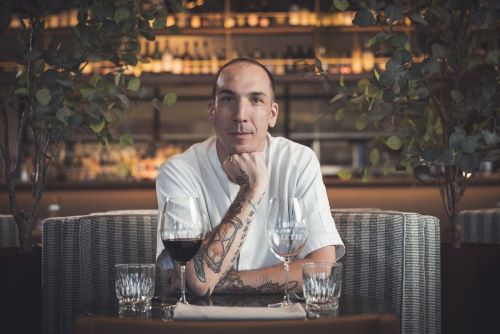
Dayan Hartill-Law is Executive Chef at Palette Restaurant in HOTA on the Gold Coast
Given this is the most asked question at your Restaurant, how would you best define Aussie Cuisine?
This has to be my favorite question to answer because I have forever run with a cuisine type of Modern Australian. For me Australia is made up of all of it’s parts, we are at our heart belonging to the indigenous people and their traditions, the native and endemic species of flora and fauna guide the understanding of the environment and the landscape. Our short history is one of migration and this in turn brought with it an Industrial Revolution that has also shaped the culinary landscape. It brought ingredients that allow us to really harness the diverse landscape Australia offers, it brought agriculture techniques that also have allowed us to bring multiple proteins to the forefront. Modern fisheries have also allowed us to delve into the rich aquaculture resources and understand the different times bring different species.
Is your culinary style influenced by your interpretation of that definition?
Unequivocally this sums up the way that I like to cook, looking for deep rich cultural connection. Then playing with those ideologies, modern takes on techniques, or interpreting indigenous ingredients, using indigenous ingredients through other cultural lens’ like bunya miso, quandong soy, candied lemon aspen. These all build the building blocks to our pantry to allow us to really have a unique style in the way in which we cook.
Which Chefs do you consider had the most influence in that evolution?
There have been so many incredibly influential chefs over the years, Peter Gilmore personally for me really shaped the way I look at food, his way with nature and looking at things as a whole steering away from the trends of the time being very classical and uniform and ensuring that lines are clean. Peter would often will the ingredients to his desire and allow the natural flow to shine. The way he was with flavor, also leaning into the indigenous ingredients list. Chefs like Jock Zonfrillo, Ben Shewry and a host of others also have shown great respect to Indigenous culture while educating diners on the incredible pantry that the indigenous kitchen holds, while doing it in an approachable fashion, that also pays respect to the deep cultural surroundings from the different ethnicities that emigrated to Australia.
What scope and direction do you think Aussie Cuisine has looking forward?
Australian cuisine truly has evolved at a rapid rate with the introduction of social media we see ourselves with immediate access to information. The ingredients are sought after as are experiences, like the dampa at Vue de Monde, the Northern Rivers endemic foraged fruits at Pipit, and the way I see our cuisine evolving is that we will lean away from central distribution and become hyper regional. This will allow us to give each region a voice, allow each region to evolve and showcase themselves. With Australia the size of Europe, we have so many varied climates that each has its own unique flavor profile and in turn voice.
Are there any specific ingredients that give us a unique and substantial point of difference?
There are so many ingredients that allow us to stand on our own, my favourite to use is the green ant, served delicately on a sashimi grade prawn. Outside of that there is the Ooray plum, the riberry falling abundantly from the trees at the moment, the quandong, the witchety grub. Then there is the way we can cheekily nod to the ‘bogan’ Australia with things like slipper lobster pie with tomato sauce, or the kangaroo parmi. We actively farm kangaroo, emu and possum. Then we also have incredible aquaculture systems with yabbies and marrons.
Do your mentor your younger chefs on understanding Aussie Cuisine?
I try to really teach into my teams that we are truly blessed with our location here on the Gold Coast, while the indigenous cultures had nomads, the Yugembeh people didn’t move as they didn’t need too. We have the ocean, the beach, the estuaries, mangroves, rainforest, dessert and bush all in the span of 40km. This means our environment is diverse, the ingredients and food resources are rich and this allows us to really look at what and who we are as a region. The mountain ranges surrounding us are all extinct volcanoes again resulting in rich agricultural grounds. The sea temperature fluctuates bringing different species at different times of the year again offering an intrinsic diversity to our plates.
When did you first start considering the question of defining Aussie Cuisine in your career?
I remember asking my 18 year old self this question and getting a not very wise answer. Something along the lines of Bogan centric cuisine being the forefront of cuisine in Australia. When really the history of Australia is the richness.
You recently collaborated with Marco Pierre White, did he ask about our Cuisine?
Marco was incredibly enamored with the stories of our region, we actually did a native tasting with him showcasing the types of things that we do like the quandong soy, the bunya miso, fermented riberry, pickled aspens. We also run a native mole which is over 400 days old and each day we cook the mole with different foraged ingredients the richness of the sauce is again intrinsic to who we are as a region. Marco also was able to talk to us about the things in our region that he has utilised before such as Rocky Point Aquacultures world leading practices, Stanbroke Beef’s incredible wagyu program and Australian Bay Lobsters commitment to sustainability.
Is there anything you would like to say on the subject that we haven’t covered?
There is so much beauty in celebrating who we are today as a nation and the more we come together and celebrate our differences, the more we will be able to grow and develop our sense of who we are as a nation and the faster our food will develop. The young chef having a go, deserves to be admired, as they form their ideologies.
